
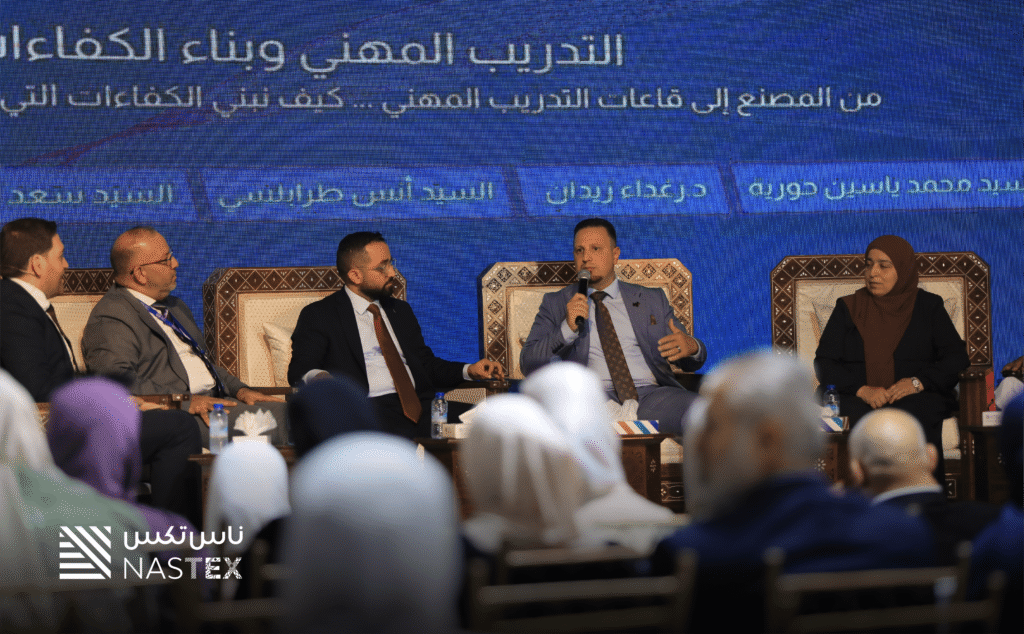
During the Nastex 2026 exhibition, the Damma Media Network booth H42 hosted a panel discussion titled “Vocational Training and Capacity Building: From Factory to Vocational Training… How Do We Build the Competencies Needed by the Textile Sector?”
The session took place on July 21, 2026, at 6:00 PM on the main stage at Damascus Fairground, featuring representatives from government bodies, the industrial sector, the International Labour Organization (ILO), and civil society organizations.
Panellists included Mr. Muhammad Yasin Houriyeh, Deputy Minister of Economy and Industry; Dr. Raghda Zaidan, Deputy Minister of Social Affairs and Labor; Mr. Anas Traboulsi, Board Member of Damascus and Its Countryside Chamber of Industry; Mr. Saad Ed-Din Muwakkit, Executive Director of HAND Organization; and Mr. Muhammad Anas Sbieh, ILO Country Coordinator in Syria.
Discussions stemmed from the necessity of supporting the anticipated expansion of textile investments with a qualified human capital, linking training directly to jobs and skills actually needed by manufacturing facilities, rather than settling for programs that do not lead to clear employment opportunities.
Watch the session now on Nastex YouTube channel
Governance of Vocational Training and Distribution of Roles
Dr. Raghda Zaidan focused on the challenge related to the multitude of entities operating in vocational training, emphasizing the need to organize their roles within a clear framework to prevent duplication of efforts and define accountability.
Vocational training in Syria involves several ministries, educational institutions, training centers, and local/international organizations; however, institutional plurality alone does not guarantee desired outcomes.
The system requires governance that defines who studies labor market needs, designs curricula, implements training, and follows up with trainees post-completion. Data sharing and coordination are also vital among the Ministries of Economy & Industry, Social Affairs & Labor, and Education, alongside chambers of industry and factory owners.
Employment-Driven Training
The panel debated the importance of transitioning to training programs that terminate in employment or grant trainees a genuine opportunity to enter the labor market.
This is realized through early communication with factory owners, identifying skill shortages, and tailoring training around those demands. Youth can be hosted in work environments to train under technical supervision, allowing facilities to recruit the most committed and capable candidates.
Labor-Intensive Sector Capable of Job Creation
Mr. Muhammad Yasin Houriyeh explained that the textile industry is labor-intensive compared to sectors reliant heavily on capital or energy.
Stages such as sewing, knitting, finishing, and garment-making demand large workforces, making the sector uniquely positioned to reduce unemployment across various skill levels. He noted that moving from raw cotton to yarn, weaving, and final goods raises the value added within the economy.
Equipment Investment is Insufficient Without Competencies
The session stressed that capital inflow and purchasing production lines do not guarantee quality or expected returns without qualified workers.
Modern machinery requires operators and technicians skilled in maintenance, quality assurance, and waste reduction. Sub-par qualification leads to technology underutilization and higher operating costs.
Anticipated Demand Surge for Skilled Labor
Participants analyzed the potential shift in Syria’s market over coming years from general unemployment to a shortage of qualified industrial labor.
Facility reopenings and investment expansion could drive demand for technical staff faster than traditional training programs can supply, necessitating proactive capacity building.
Worker and Employer: Partners in Success
Mr. Anas Traboulsi presented the private sector’s vision, asserting that workplace relations must transcend a basic “wage-for-labor” transactional mindset. Workers are integral to product quality and market access, while worker stability relies on enterprise growth.
Export Demands New Skills and Standards
The session linked vocational training to the capacity of Syrian factories to re-enter regional and international markets. Exporting to competitive markets requires consistent quality, compliance, documentation, and occupational safety—goals attainable only through trained personnel.
Demand-Driven Market Training
Mr. Muhammad Anas Sbieh outlined the ILO’s approach: training programs must be driven by real market demand. Rather than launching courses and seeking placements afterward, programs should start by identifying the exact skills employers lack.
Sectoral Skills Councils
Participants reviewed a proposal to establish Sectoral Skills Councils bringing together government agencies, educational institutes, chambers of industry, and plant owners to regularly assess emerging skill demands.
Independent Skill Assessment
The panel highlighted the need for independent trainee evaluation rather than relying solely on the course instructor, ensuring greater certification credibility for employers.
Factories as Practical Training Hubs
Private sector representatives advocated for opening factories to institute and university students, converting production lines into practical vocational education hubs.
Dedicated In-Factory Mentors
An international model was highlighted involving dedicated internal factory mentors assigned specifically to supervise trainees and track skill progression.
Training Tied to Imported Technologies
Mr. Anas Traboulsi discussed technology suppliers’ responsibility, urging that machine procurement contracts include mandatory local technical training and knowledge transfer.
Digital Platform Connecting Youth with Factories
The panel proposed a digital platform allowing youth to choose desired trades and matching them with relevant training centers and factory apprenticeship slots.
Upgrading Training Centers and Curricula
Mr. Muhammad Yasin Houriyeh noted that several training centers face outdated machinery and curricula. Systemic reform demands infrastructure rehabilitation, modern equipment, and continuously trained instructors.
Fast-Track Training to Address Unemployment
Dr. Raghda Zaidan touched on combining long-term vision with fast-track solutions providing youth basic entry-level competencies to secure immediate income.
Opportunities for Women in Textile Trades
The session showcased opportunities for women in tailoring, embroidery, carpet weaving, silk work, and product design, emphasizing flexible community-based training models.
Region-Specific Training Customization
Mr. Saad Ed-Din Muwakkit clarified that vocational training shouldn’t follow a one-size-fits-all model across governorates, as Aleppo’s industrial needs differ from coastal or tourism-oriented regions.
Civil Society’s Role in Economic Recovery
HAND Organization emphasized civil society’s agility in connecting directly with youth and business owners to facilitate public-private partnerships during the recovery phase.
Shifting Social Perceptions of Vocational Education
The panel addressed the necessity of tackling social stigmas surrounding vocational trades compared to academic degrees, advocating for clear awareness around competitive industry wages.
Data as the Foundation for Program Design
The ILO representative reaffirmed that effective training development relies on accurate labor market statistics, employer surveys, and skill-gap mappings.
Vocational Training as a National Priority
The session concluded that vocational training must be treated as a unified strategic national file supported by sustainable funding and integrated economic policies.
From Training to Decent Work
The ultimate objective of vocational training is facilitating access to decent work and sustainable income, reinforcing social cohesion and economic stability.
Damma and Nastex: A Stakeholder Gathering Platform
The panel exemplified Damma Media Network’s role in convening key stakeholders, inviting all industry participants to join the upcoming exhibition edition.
Register for Nastex 2027
Nastex 2027 offers a platform to build partnerships connecting training to employment and developing programs responsive to modern industry needs. Register now to participate in Nastex 2027.