
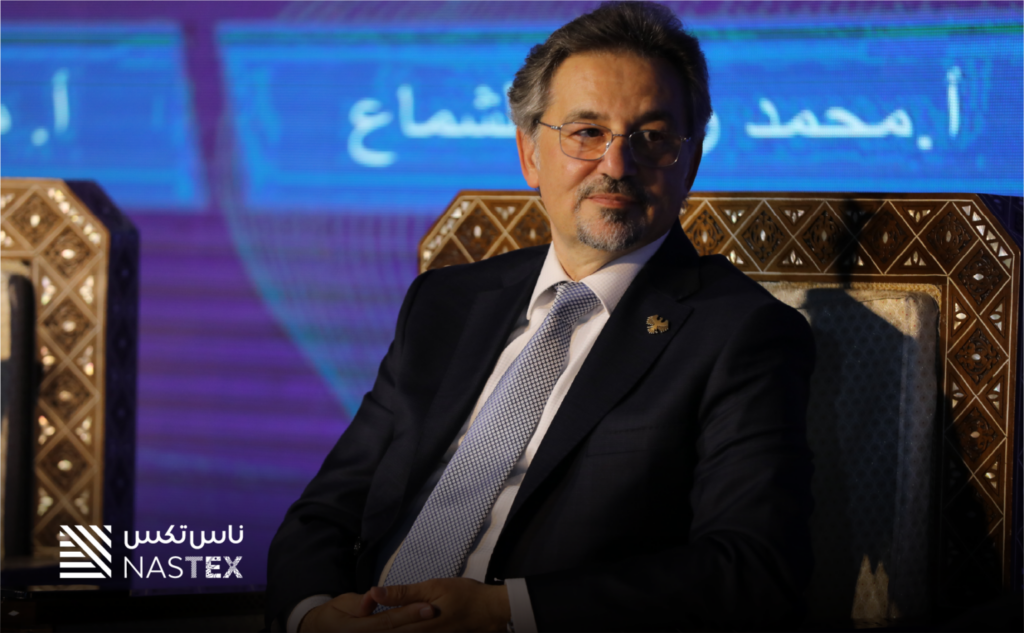
The Damma Media Network pavilion H42 at NASTEX 2026 hosted a panel bringing together government officials, industrial representatives and experts to discuss the current state of Syrian manufacturing and the opportunities available for rebuilding the textile sector.
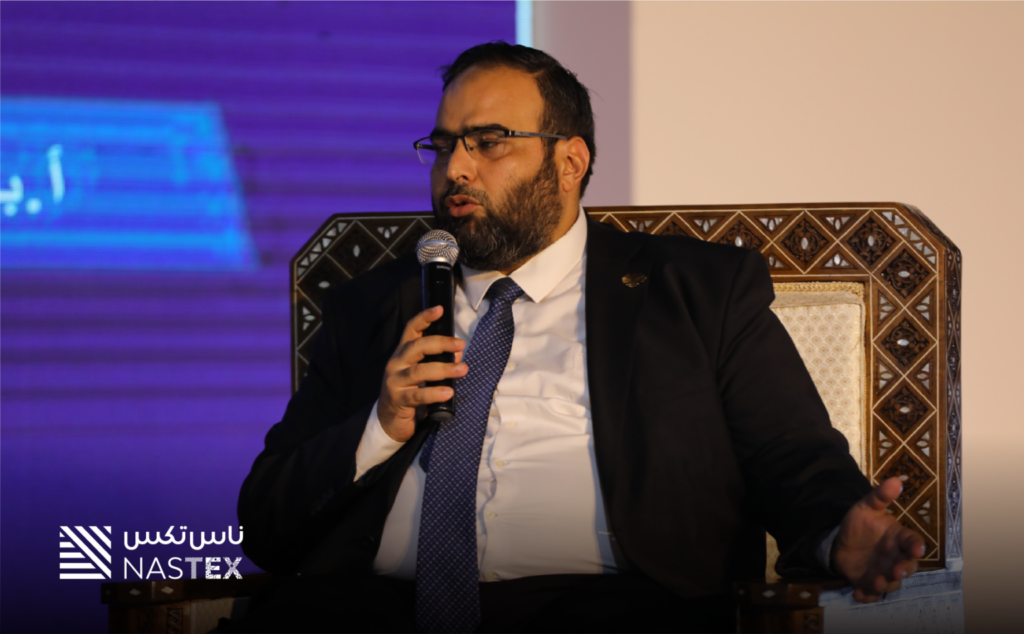
Participants included Basel Abdel Hanan, Deputy Minister of Economy and Industry; Mohammad Raafat Al-Shamaa, Board Member of the Aleppo Chamber of Industry; Adham Tabbah, Board Member of the Damascus Chamber of Industry; and Muntaser Qalaaji, industrial expert and Deputy CEO of the Syrian-Saudi Business Council.
The discussion was moderated by Hassan Fallaha. During the session, Mohamed Al-Raeid, Chairman of the General Union of Chambers of Commerce, Industry and Agriculture in Libya, joined the panel to discuss bilateral trade and the potential for Syrian textiles to access Libyan and neighbouring African markets.
Connecting Government with the Industrial Sector
The session created a direct dialogue between public institutions, chambers of industry and private manufacturers.
It highlighted the need to replace fragmented interventions with a comprehensive strategy connecting agriculture with manufacturing, finance with technology and production with branding and exports.
Participants also stressed that industrial policy should respond to the practical requirements of factories and encourage private-sector participation across the textile value chain.
Cotton as the Starting Point of the Value Chain
Basel Abdel Hanan highlighted cotton as a central component of Syria’s textile recovery.
He discussed coordination with the Ministry of Agriculture, plans to expand production and the gradual participation of private companies in ginning and spinning.
New production lines are beginning to enter the sector, while some existing lines are being adapted for cotton processing.
Syria’s existing ginning and spinning capacity could provide a foundation for reconnecting agricultural production with industrial manufacturing.
Spinning Connects Agriculture with Manufacturing
Adham Tabbah described ginning and spinning as a pivotal link between farms and downstream textile industries.
Private investment in gins and spinning facilities could address one of the principal gaps in the production chain.
The discussion also referred to investor interest in spinning projects and contract-farming models.
Under such arrangements, farmers can gain a clearer buyer for their crops while factories receive more stable supplies of raw materials.
This model could serve local demand and support the production of yarn, fabrics, garments and other higher-value products.
Textiles as Part of Syrian Identity
Muntaser Qalaaji emphasised that textiles are connected not only to the economy but also to Syria’s cultural memory and identity.
He argued that the objective should not simply be to restore the industry to its former position.
Instead, Syria should begin from the level reached by leading international industries and identify a clear competitive advantage of its own.
This requires a holistic approach extending from agriculture and ginning to spinning, weaving, apparel, design, marketing and distribution.
Building Syrian Brands
The panel raised an important question about whether Syrian factories should focus solely on producing for international brands or develop brands of their own.
Contract manufacturing can generate orders and employment, but the greatest commercial value is often captured by companies controlling the brand, marketing and customer relationship.
Developing Syrian brands requires investment in product design, quality, packaging, market research and communication.
It also requires dependable production capacity and the ability to meet delivery schedules and market standards.
Industrial Finance and Machinery Modernisation
The need to modernise machinery and production lines emerged as one of the sector’s principal challenges.
A broad industrial recovery cannot depend exclusively on self-financing by a limited number of manufacturers.
Specialised industrial finance is therefore needed to help existing factories upgrade their capabilities and enable new investors to establish competitive production lines.
Financing should be connected to technical studies, productivity objectives and realistic market opportunities rather than limited to the purchase of equipment.
Lean Manufacturing Before Automation
The discussion stressed that factory modernisation involves more than purchasing new machinery.
Manufacturers need to improve production planning, material flow and inventory management through lean manufacturing principles.
Reducing waste and controlling materials accumulated between production stages can free capital and improve efficiency.
Automation, robotics and advanced systems can then be introduced within a properly organised production environment.
A factory is not merely a building containing machinery. It is a system of accumulated technical expertise, management processes and skilled people.
Training and Rebuilding Industrial Expertise
Participants addressed the loss of industrial expertise caused by the departure of engineers, technicians and skilled professionals during previous years.
The sector needs programmes that attract experienced Syrian professionals and prepare a new generation for modern manufacturing, maintenance, quality control, production management and industrial marketing.
Training must therefore develop alongside finance and machinery modernisation.
Without skilled people capable of operating and improving industrial systems, investment in advanced equipment will not produce its full value.
Energy and Production Stability
Electricity prices, quality and reliability were also discussed as factors affecting factory efficiency.
Interruptions and fluctuations can cause downtime, damage machinery and products and increase maintenance and waste.
A competitive textile sector consequently requires progress in energy and infrastructure alongside finance, skills and production technology.
Increasing Local Content
Textile manufacturing offers Syria an important advantage: the possibility of building a value chain with a high proportion of local inputs.
Greater integration among cotton cultivation, ginning, spinning, weaving, dyeing, finishing and garment manufacturing can retain more value inside the Syrian economy.
This model can create employment, reduce dependence on imports and support products with a more complete Syrian industrial identity.
Libya as a Potential Gateway to Africa
Mohamed Al-Raeid highlighted the economic and social connections between Syria and Libya and the potential for bilateral trade and investment.
He described Libya as a market with its own demand and as a potential gateway to neighbouring African economies.
Syrian textile products could gain a stronger position in Libya through reliable commercial relationships, distribution channels and cooperation between business communities in both countries.
Register for NASTEX 2027
Manufacturers, investors, technology providers, chambers of industry, business councils, financial institutions and training organisations are invited to participate in the next edition of the Syrian International Textile Exhibition.
NASTEX 2027 will provide a platform for discussing sector requirements, presenting industrial solutions and building partnerships connecting Syrian production with finance, technology and international markets.