
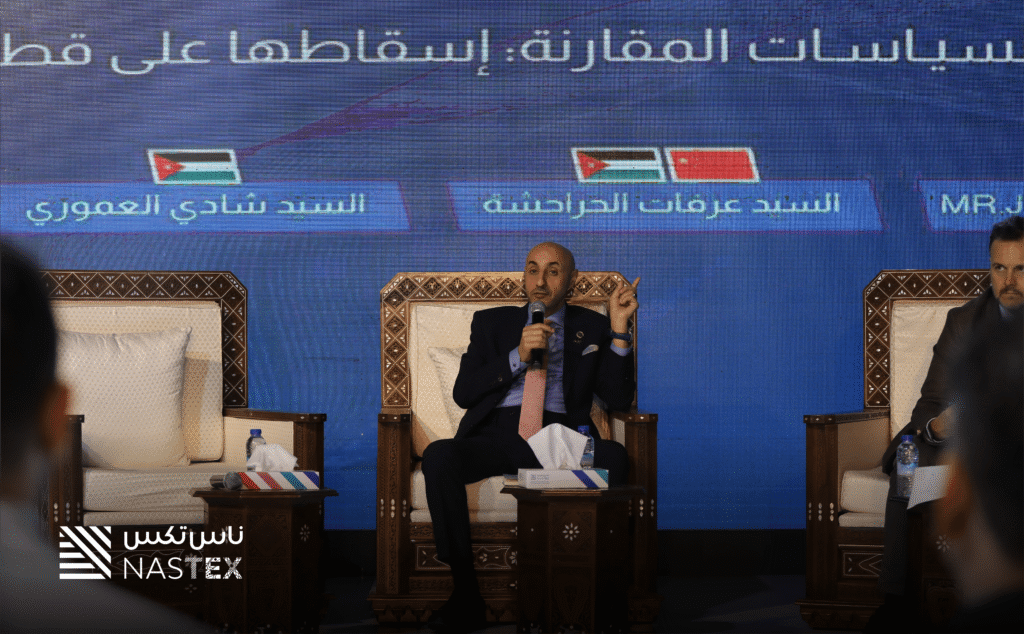
NASTEX 2026 hosted a panel discussion titled “International Models and Comparative Policies: Applying Them to the Syrian Textile Sector”, examining how international experiences can be studied and adapted to meet the realities and future needs of Syria’s textile industry.
The session was held on 20 July 2026 on the main stage at the Damascus Fairgrounds as part of the dialogue programme organised by Damma Media Network during NASTEX.
Participants included José Manuel Medina Chica, Senior Regional Specialist for Employers’ Activities at the International Labour Organization; Arafat Al-Harahsheh, representative of the Arab Businessmen Forum in China; Shadi Al-Amouri, Business Developer at Revton; and economic expert Abdul Majid Saqal.
International Experience: From Replication to Adaptation
The discussion focused on the importance of studying the experiences and policies adopted by countries to develop their industrial sectors.
Participants emphasised that benefiting from international experience does not mean transferring policies without modification. It requires analysing the conditions that contributed to their success and adapting them to Syria’s economic, legislative and productive environment.
Syria’s textile sector has distinctive characteristics linked to its industrial history, the diversity of its enterprises and its accumulated craft and professional expertise.
Developing the sector therefore requires policies that benefit from international standards while preserving local strengths and taking available resources into account.
The discussion also examined how international comparisons can help identify strengths and gaps within the sector and develop clearer approaches to modernising facilities, improving skills, raising production quality and strengthening the competitiveness of Syrian products.
Policies Supporting Employers and Industrial Enterprises
The participation of a representative from the International Labour Organization introduced a perspective focused on employers’ activities and the importance of creating an environment that enables institutions and enterprises to grow and remain sustainable.
This should take place alongside skills development and improvements in management and production methods.
Dialogue between international organisations, business owners and local experts provides an opportunity to examine tools and practices used in different markets and determine which of them can be applied within Syria’s textile sector according to its actual priorities and needs.
Involving the private sector in the development of industrial policies also helps align those policies with the realities of enterprises.
It enables relevant institutions to better understand the challenges manufacturers face when expanding operations, entering export markets or adopting new technologies.
China and Applicable Industrial Experience
The participation of the representative of the Arab Businessmen Forum in China added an important dimension to the session, given China’s extensive industrial and commercial experience and its role in machinery, technology, manufacturing and supply chains.
The panel discussed the importance of building communication channels between businesspeople and industrialists and using economic relationships to access modern technologies, exchange expertise and explore cooperation opportunities that can support the modernisation and efficiency of the textile sector.
Benefiting from Chinese and other international experiences should not be limited to importing machinery.
It also includes examining models of management, training, marketing, production-chain organisation and the integration of small and medium-sized enterprises into larger markets.
Innovation and Business Model Development
The session also highlighted the role of business development and innovation in helping textile companies respond to rapid market changes.
This includes developing products, improving customer experience, adopting digital solutions and building brands capable of communicating the value of Syrian products instead of competing solely on price.
Modern business models can also connect manufacturing with design, technology, e-commerce and exports, creating new opportunities for enterprises to reach customers and markets.
An Economic Perspective on the Sector
The participation of economic expert Abdul Majid Saqal provided a broader economic reading of the sector.
The discussion connected industrial policy with financing, investment, production costs, domestic demand and access to external markets.
Developing the textile industry requires an integrated vision that does not address each challenge separately.
Instead, it should connect raw materials, energy, financing, production, marketing and exports within a clear value chain capable of generating sustainable returns.
NASTEX as a Space for Dialogue and Knowledge Exchange
The panel reflected NASTEX’s role as a platform that extends beyond displaying products and machinery.
The exhibition also brings together experts, international organisations and business leaders to discuss the policies shaping the future of the textile sector.
By combining international expertise, economic analysis, business experience and business development perspectives, the session opened a broader discussion on how to build a Syrian textile industry that benefits from global experience without losing its local identity or becoming disconnected from its economic and industrial realities.