
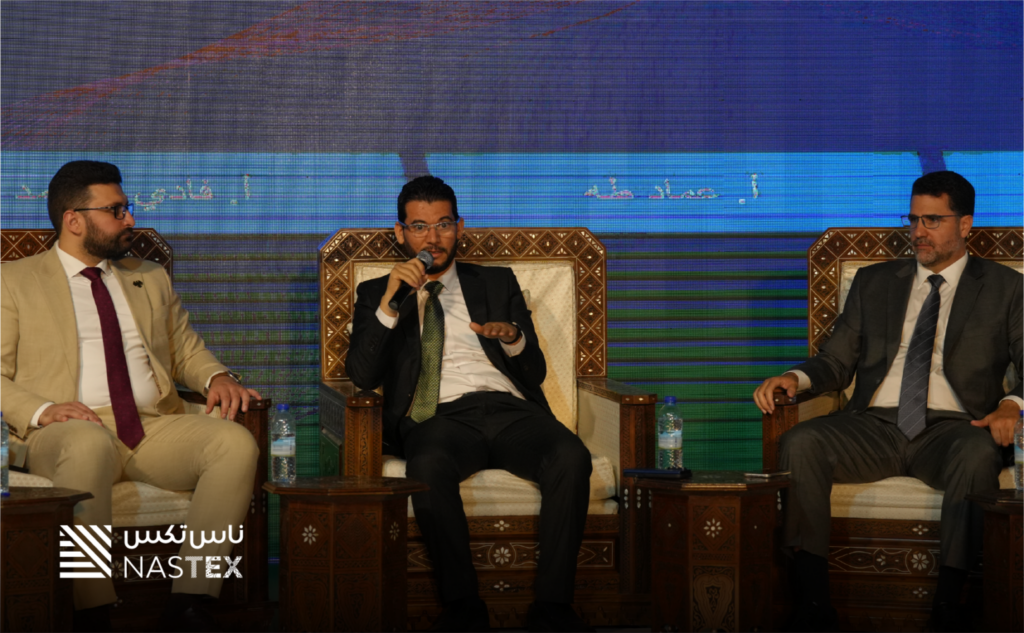
A specialised session held during NASTEX 2026 examined investment opportunities in Syria’s textile sector, the challenges facing manufacturers and the role of financial and investment institutions in supporting factory modernisation.
The session brought together Fadi Al-Ahmad, founder of NASTEX and Chairman of its Higher Committee, Abdullah Al-Albi, Chairman of the Industrial Bank and a development expert, and Muadh Haqqi, Assistant Director-General for Investment Services.
Discussions covered production-line financing, support for small and medium-sized enterprises, investment legislation, administrative simplification and the adoption of modern industrial technologies.
Watch the session now on Nastex YouTube channel
NASTEX as an Integrated Textile Ecosystem
Fadi Al-Ahmad explained that NASTEX extends beyond the conventional definition of a specialised trade exhibition.
It represents an integrated ecosystem bringing together financing, entrepreneurship, production lines, enterprise resource planning systems, technology, investment, training and textile value chains.
One of the exhibition’s central messages is that Syria can restore its position within the textile industry by connecting its accumulated manufacturing experience with advanced global technologies.
Development-Oriented Industrial Finance
Abdullah Al-Albi discussed the role of the Industrial Bank as a development institution whose work should extend beyond conventional lending.
He highlighted the need for specialised financing programmes for new production lines, industrial technology, entrepreneurs and small and medium-sized enterprises.
These companies can contribute to employment, production growth, product development and the expansion of Syria’s textile manufacturing base.
The session also examined how banks can support investors through training, project evaluation and business-development services rather than providing finance alone.
Sharia-Compliant Financing Solutions
Al-Albi referred to growing demand for Sharia-compliant industrial financing products, including murabaha and istisna’a arrangements.
Such instruments could provide additional options for manufacturers seeking to finance machinery and production lines without relying on conventional interest-based loans.
The discussion also addressed more flexible guarantee mechanisms, including cooperative guarantees among groups of industrialists, rather than depending entirely on property and traditional collateral.
Investment Incentives for Manufacturers
Muadh Haqqi presented a range of services and incentives designed to support industrial investors, particularly those seeking to import new production lines.
He explained that the emerging investment framework includes customs-related incentives for production equipment and tax benefits for projects exporting a significant share of their output.
The session also addressed guarantees related to the transfer of capital and profits, protection against arbitrary intervention and full ownership opportunities for certain foreign companies under the applicable legal framework.
Authorities are also working towards updated investment legislation informed by practical experience and the needs of productive sectors.
Administrative Simplification and Digital Transformation
Participants discussed administrative procedures and bureaucracy as continuing challenges for investors and manufacturers.
Improving the investment environment requires more than financial incentives. It also depends on faster licensing, simplified approvals and digital government services.
Digital transformation can reduce the time and effort required to complete procedures and provide investors with clearer mechanisms for tracking applications.
The session indicated that initiatives are being developed to digitise investment services and support more flexible procedures in the coming period.
Industrial Technology as a Competitive Foundation
The session stressed that Syrian factories should not begin their modernisation journey with outdated technology.
Instead, manufacturers should examine enterprise resource planning systems, industrial artificial intelligence, the Internet of Things, robotics, automation and data analytics.
These technologies are not used solely to replace workers. They can improve quality, accelerate production, strengthen process monitoring and reduce errors and material waste.
Participants called on financial institutions to introduce programmes that finance digital systems and industrial technology alongside conventional buildings and machinery.
A Complete Factory Model Inside NASTEX
Fadi Al-Ahmad presented the ORYX shemagh factory as an example of how NASTEX displays investment opportunities in practical form.
Rather than showing individual machines, the exhibition presented an integrated production model combining machinery, ERP systems, artificial intelligence, order management, market studies and cost-and-return calculations.
The model was designed to help investors understand the entire project—from the initial order through production and delivery—and access the information required for an informed investment decision.
This approach shifts investment promotion from general presentations towards industrial models that can be evaluated and implemented.
Opportunities Greater Than the Challenges
Participants acknowledged that the Syrian market continues to face administrative, financial and operational challenges.
However, they argued that the scale of opportunities in productive sectors gives early investment particular importance.
Muadh Haqqi noted that some industries are already attracting stronger investor interest and that waiting for a perfect moment could result in missing valuable opportunities.
Early investors may benefit from entering markets with unmet demand and establishing a position before competition increases.
Measuring the Success of NASTEX
The session examined the criteria that should be used to evaluate the exhibition after its conclusion.
Success is not limited to visitor numbers or organisational quality.
It also includes exhibitors securing deals, meeting new partners, acquiring knowledge and gaining access to advanced machinery and industrial systems.
The exhibition’s long-term value will be measured by its ability to transform meetings into projects, transfer technology to factories and open investment and financing channels for the textile industry.
Towards a New Phase for Syrian Industry
The session demonstrated that developing Syria’s textile sector requires cooperation among investors, banks, government institutions, technology providers and training organisations.
Finance without knowledge may not achieve the required results, while technology without training or a suitable investment environment may not lead to sustainable production.
NASTEX seeks to bring these components together within a cooperative ecosystem capable of supporting productive factories, competitive products and a stronger Syrian presence in regional and international markets.
Register for NASTEX 2027
Investors, manufacturers, financial institutions, technology providers, entrepreneurs and industrial organisations are invited to participate in the next edition of the Syrian International Textile Exhibition.
NASTEX 2027 will provide a specialised platform for exploring investment opportunities, presenting industrial technologies and connecting Syrian factories with finance, expertise and international markets.