
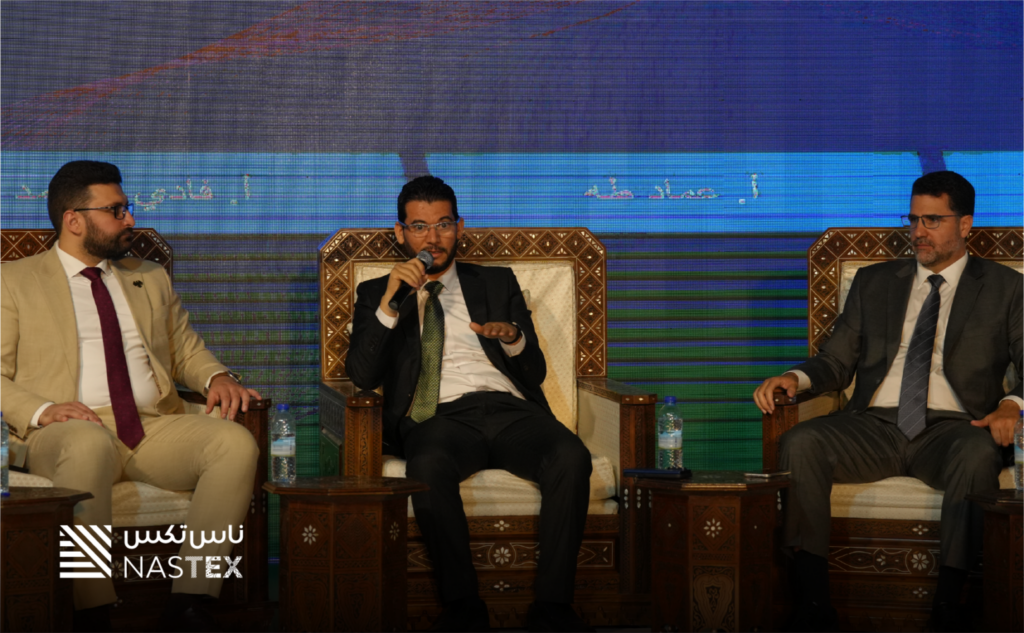
The panel discussion “Investment Opportunity Map: Syrian Textiles — Why Now?”, held during the first day of NASTEX 2026, examined the factors that make Syria’s textile sector a promising field for investment, as well as the services and financing mechanisms required to establish projects and support industrial development.
The session featured Fadi Al-Ahmad, founder of NASTEX, Chairman of the Syrian-Chinese Business Council and a private-sector investor; Muath Haqqi, Assistant Director General for Investment Services Affairs at the Syrian Investment Authority; and Abdullah Al-Albi, Chairman of the Board of the Industrial Bank.
The discussion brought together three interconnected dimensions of the investment process: the investor’s perspective and private-sector requirements, the role of the Syrian Investment Authority in facilitating procedures and providing services, and the importance of banking finance in transforming available opportunities into implementable production projects.
Why Is the Syrian Textile Sector an Investment Opportunity?
The session began with a central question: why is the current stage suitable for investment in Syria’s textile sector?
The sector possesses accumulated expertise, specialised labour and an industrial base that can be rehabilitated, modernised and expanded.
Its value chain also covers a wide range of activities. Opportunities begin with raw materials and yarn production, and extend to weaving, dyeing, printing and finishing, before reaching ready-made garments, furnishings, design, branding and exports.
This diversity creates space for projects of different sizes, from small and medium-sized enterprises to large factories and integrated production lines.
It also opens investment opportunities in supporting industries, including packaging, logistics, industrial software, energy solutions, maintenance and spare parts.
Investors Need Opportunities and a Clear Roadmap
Fadi Al-Ahmad’s contribution addressed the private sector’s perspective on investment and the importance of presenting opportunities through clear, comprehensive information that enables investors to assess them and make informed decisions.
Investors require more than a general description of an opportunity. They need information on market size, raw materials, production capacity, costs, infrastructure, financing, target markets and the expected timeline for reaching operational capacity.
The session also discussed the importance of building partnerships between Syrian investors and counterparts from other countries, while using business councils to connect companies, exchange information, transfer expertise and technology, and access new markets.
Al-Ahmad’s participation, as the founder of NASTEX, Chairman of the Syrian-Chinese Business Council and a private-sector investor, contributed a perspective focused on connecting Syria’s industrial capabilities with international markets, technology and external partnerships.
Investment Services: From Identifying the Opportunity to Operations
Muath Haqqi, Assistant Director General for Investment Services Affairs at the Syrian Investment Authority, presented a perspective centred on the services investors require throughout the different stages of establishing a project.
The investment journey includes obtaining initial information, evaluating the opportunity, communicating with relevant institutions, completing approvals and licences, addressing procedural challenges and moving towards implementation and operations.
The session emphasised that the success of an investment map does not depend solely on the number of opportunities presented. It also depends on their readiness, the clarity of their data and the ability to support investors throughout the project’s different stages.
This highlights the importance of an effective investment window, follow-up services and coordination between government institutions, helping shorten procedures and provide investors with a clearer path from initial interest to production.
Industrial Finance: Turning Opportunities into Factories
Financing formed one of the session’s central themes, with the participation of Abdullah Al-Albi, Chairman of the Board of the Industrial Bank.
The discussion examined the role of banking institutions in supporting productive projects and providing financing instruments suited to the nature of industrial investment.
Industrial projects differ from short-term commercial activities. They require financing for machinery, production lines and equipment, in addition to working capital, and they often need time before beginning production and generating returns.
Developing the textile sector therefore requires financing solutions that take into account the industrial project cycle, the size of the investment, the establishment and operating periods, and the enterprise’s repayment capacity.
The session also highlighted the importance of financing the modernisation of existing factories, improving production efficiency and introducing advanced technologies, rather than limiting financing to newly established projects.
Opportunities Across the Entire Production Chain
The panel discussed a range of opportunities across the textile sector, including restarting inactive facilities, modernising production lines, establishing new factories and developing industries related to spinning, weaving, dyeing, garments and furnishings.
Additional opportunities include introducing automation, enterprise resource planning systems, digital solutions and artificial intelligence to improve production management, strengthen quality control and reduce waste and operating costs.
Investment in design, marketing and brand development can also increase the added value of Syrian products and help the industry move from basic production towards finished goods capable of competing in regional and international markets.
Integrating Investment, Finance and Market Access
The discussion demonstrated that the development of the textile sector cannot be achieved by a single institution. It requires coordination among investors, government bodies, financial institutions and business councils.
The Syrian Investment Authority facilitates procedures and provides investor services, while the Industrial Bank offers financing instruments. The private sector and business councils, meanwhile, identify opportunities, develop partnerships and connect production with markets.
This integration reflects one of NASTEX’s primary objectives: bringing manufacturers, investors, technology providers and economic and financial institutions together to move from presenting opportunities to developing practical mechanisms for implementation.
From an Opportunity Map to Actual Projects
The session concluded that the central question is no longer whether investment opportunities exist in Syria’s textile industry, but how these opportunities can be prepared, financed and transformed into real projects.
This requires accurate information, clear procedures, integrated investor services, appropriate industrial financing and connections between projects, markets and potential partners.
Through the participation of Fadi Al-Ahmad, Muath Haqqi and Abdullah Al-Albi, the panel presented three essential keys to investment in the sector: a clearly defined opportunity, effective investment services and appropriate industrial financing.
The session also reflected NASTEX’s role as a platform that goes beyond presenting the current state of the industry. It creates practical dialogue about its future and brings together the stakeholders capable of transforming Syria’s textile potential into investment, production, employment and access to new markets.